Talent Pass presented its secondment model to researchers, research managers and policy experts at the 3rd ERA SHUTTLE Summer School, held on 5–9 October 2026 at the University of Malta's Valletta Campus.
The Summer School, "Career and Personal Growth for Human-Centric Leadership in the European Research Area (ERA)", is organised by the ERA SHUTTLE project (HORIZON-WIDERA-2022-TALENTS-03). Its fourth day, 8 October, was titled "From Mobility to Impact: Lessons from ERA Talent Projects" and brought together sister projects from the ERA Talents 2022 and 2024 calls.
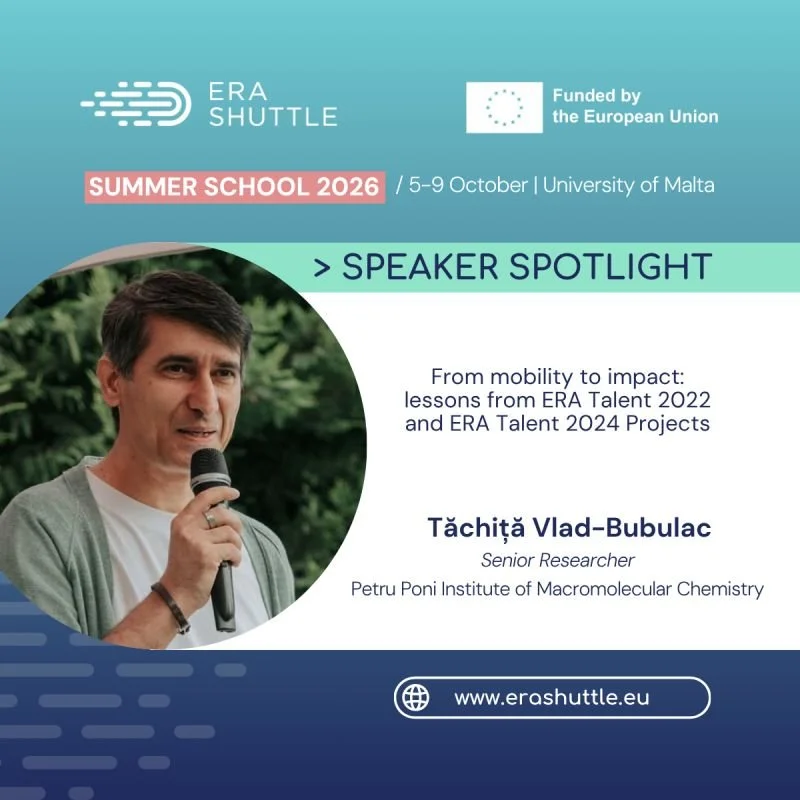
The day was moderated by Marina Coricciati (CERIC-ERIC, ERA SHUTTLE M&E work package leader). Dr. Tăchiță Vlad-Bubulac (ICMPP), Talent Pass WP2 Leader for Secondments and Mentoring, represented the project alongside Andreja Jagnjić (ERA SHUTTLE), Janika Leoste (EdTech Talents), Marija Radosavljević (USE IPM) and Lukáš Daubner (SECURE-NET).
Talent Pass secondments: from methodology to institutional impact
In the opening showcase session, Dr. Vlad-Bubulac presented "Talent Pass secondments: from methodology and implementation to skills development and institutional impact". The talk walked through how WP2 connects 10 partners from 7 countries to exchange talents between academic and non-academic organisations in the circular economy.
A transparent, merit-based selection. Candidates first check their eligibility (employment, English level, institutional support), then apply online with a CV, a Letter of Support and a Career Development Plan. Applications are scored in two stages, documents and an interview at each home institution, each worth 35 points. A total of 70 points is needed for recommendation, and approved and reserve candidates are ranked by final score.
A hosting plan for 22 secondees. The plan covers 36 mobilities in 2026, with secondments running through 2026–2028. The 22 talents include 12 researchers (up to two months), 7 administrative staff, 2 management staff and 1 technical staff member (up to one month each). Each activity plan is co-designed with home and host mentors and tracked through activity logs, milestones and periodic reporting.
A support package around every secondee. Each talent has a home and a host mentor, a personal Career Development Plan and access to coaching visits, in which experts spend short periods on site. A return framework covers re-induction, feedback and a review three months after return.
Measurable institutional impact. Talent Pass aims for 15 project proposals, 20 articles (5 of them joint) and 10 cooperation agreements. Beyond these targets, the project expects stronger R&I support capacity in partner organisations and two-way access to know-how and infrastructure between academia and industry.
Two panels on the secondee journey and lasting change
The showcase was followed by two panel discussions with the same five projects, both moderated by Marina Coricciati.
The first panel, "The Secondee Journey", compared secondment methodologies, capacity-building approaches and the lessons each project has learned so far. Speakers shared institutional practices that help secondees prepare, settle in at the host organisation and bring results home.
The second panel, "Institutional Impact & Barriers", turned to the administrative bottlenecks that slow mobility in Widening countries. The discussion focused on how secondments can drive lasting structural change rather than remain one-off individual experiences.
Key messages from Talent Pass
Across the three sessions, Talent Pass shared five lessons from its secondment programme:
Design secondments around fit. Talents are matched to hosts based on partners' mapped R&I resources and each person's Career Development Plan.
Support the return, not only the stay. Dual mentoring, coaching visits and a structured return framework help secondees put new skills to use back home.
Measure skills through results. Success shows in new collaborations, proposals, improved processes and colleagues trained by returning secondees.
Reduce administrative friction early. Early planning, standard templates, one contact person per institution and procedures shared across partners keep mobilities on track.
Include research support staff. Research support is often the real bottleneck in Widening countries, so administrative and management staff are seconded alongside researchers.
What comes next
The lessons shared in Malta feed directly into the next phase of Talent Pass. In October and November 2026, experts from UNISMART, Crowdhelix and Farplas are carrying out coaching visits to ECOIND and ICMPP. Monitored mobilities for all 22 secondees continue through 2028, supported by the return and reintegration framework developed under Task 2.5.
About Talent Pass
Talent Pass – Fostering European Talents for Widening Circular Economy is a Horizon Europe project (GA 101217448) that builds a cross-sectorial R&I talent ecosystem for the circular economy. Through secondments, mentoring and training, it helps academic and non-academic organisations exchange talents, reverse brain drain and boost careers.
